
- Executive Summary
- Who This Report Is For
- How To Read This Report
- Macro Base: Greater Bay Area Over 1-5 Years
- Three Household Balance Sheets
- H2S-FAST and CDI
- 30 Next-Generation Development Paths
- Seven Practical Constraints
- High-Cost Education and Cultural Capital
- Why This Is Public Flagship Research
- How To Keep Reading and Watching
This is a public flagship research report built to explain mechanisms. It does not diagnose any family, and it does not treat path samples as forecasts. Its purpose is to provide a shared framework for understanding why asset-holding urban households in the Greater Bay Area may rethink assets, education, careers, responsibilities, and next-generation capability over the next few years.
Executive Summary
-
The first mechanism is the shift from balance-sheet comfort to cash-flow comfort. Homes, shops, factory space, private-company equity, and receivables may look substantial. When liquidity, profits, retirement, and medical spending change together, the resources that can actually be used by the family may be reinterpreted.Official dataInstitutional reportsModel judgment
-
The second mechanism is that opportunity remains, but it increasingly rewards capability verified by industries, clients, and organizations. Shenzhen still offers technology manufacturing, cross-border services, AI workflows, and financial-service opportunities. But property dependence, a single education label, social resources, and family support are less likely to create new growth on their own.Official dataMarket signalsModel judgment
-
The third mechanism is that education is repriced from status credential to verifiable capability. Useful education has to produce replicable skills, commercial collaboration, client access, asset-governance literacy, and cross-context adaptability. Without these, high-cost education becomes a label-based investment with uncertain economic return.Institutional reportsMarket signalsModel judgment
-
The fourth mechanism is that family responsibility reprices the freedom of younger family members. Overseas study, entrepreneurship, employment, marriage, and residence choices are shaped by parental health, business control, sibling allocation, debt guarantees, and family cash-flow discipline.Lived-experience signalsModel judgment
-
The fifth mechanism is that marriage and family boundaries are moving from background judgment to responsibility judgment. Family assets still matter. But personal cash flow, liability transparency, parental health, living arrangements, and caregiving responsibilities increasingly affect long-term matching and family negotiation.Lived-experience signalsModel judgment
-
The sixth mechanism is that cultural capital must connect to real systems. Art, music, design, content, and elite-school experiences still have value, but the question is whether they connect to clients, projects, teaching, copyright, technical tools, brand services, or family industries.School dataEmployment dataMarket signals
-
The seventh mechanism is that divergence comes from capability combinations, not from a single degree, asset, or identity label. Capability compounding, industrial operation, licensed professional tracks, cross-border rule literacy, and low-consumption stability tend to be more resilient under pressure.CDI modelScenario analysis
-
This report focuses on asset-holding urban households facing cash-flow and responsibility constraints, and does not generalize its conclusions to all families. Asset scale, industry source, family structure, and leverage can create very different paths.Model judgment
Who This Report Is For
This report is mainly written for three groups.
- Asset-holding urban households in the Greater Bay Area. This refers to families with property, business equity, professional income, or cross-border asset arrangements that still need to rethink cash flow, leverage, responsibility, and liquidity.
- Younger members moving through education, career, or family-responsibility transitions. This includes people in overseas education, professional training, art education, return-to-China planning, entrepreneurship, family-business participation, or early independent cash-flow formation.
- Observers of education, family assets, and generational transition. This includes parents, education planners, family-business service providers, wealth-management practitioners, and researchers.
This report does not assess individual cases, and it does not provide investment, legal, tax, immigration, education-placement, or personal wealth-planning advice.
How To Read This Report
| Material type | What it is used for | What it cannot do |
|---|---|---|
| Official data | Macro conditions, city economy, school fees, and hard constraints | It cannot determine a household outcome by itself |
| Institutional reports | Wealth segmentation, employment, education, and industry trends | It cannot replace a household cash-flow audit |
| Market signals | Recruitment, projects, clients, education spending, and monetization windows | It is not a strict statistical sample |
| Lived-experience signals | Details such as parental control, transition anxiety, and social-circle change | A single post cannot represent a group |
| Model judgment | Comparable sandbox paths built from multiple variables | It is not a prediction or destiny label |
H2S-FAST and CDI are Taiwha self-built sandbox models for this report. Their value is to break complex family issues into reviewable variables, not to produce precise forecasts.
Macro Base: Greater Bay Area Over 1-5 Years
Baseline judgment: the next five years are neither simple upside nor simple downside. Total growth may continue, but structural divergence between families is likely to become more visible.Official dataInstitutional reportsModel judgment
China still recorded positive growth in the first quarter of 2026. The National Bureau of Statistics reported real year-on-year GDP growth around 5%, while real estate, employment expectations, household balance sheets, and private-enterprise profits remained key pressure points.National Bureau of StatisticsOfficial data
Shenzhen remains stronger than many cities because of technology manufacturing, electronics, software services, cross-border trade, finance, and innovation density. But the threshold for opportunity is higher. The older sequence of buying property, studying abroad, joining a large platform company, or starting a business through family resources is giving way to technology or industry understanding, commercialization, cash-flow discipline, and cross-border compliance.Shenzhen Statistics BureauOfficial dataModel judgment
The Greater Bay Area remains one of China’s most important city clusters. Hong Kong, Macao, Guangzhou, Shenzhen, Foshan, Dongguan, Zhuhai, Zhongshan, Huizhou, Jiangmen, and Zhaoqing form a network of manufacturing, finance, logistics, technology, education, and cross-border life.Greater Bay Area official portalOfficial dataModel judgment
International institutions broadly point to the same direction: growth continues, but medium-term growth is slower than in the past, and real estate, debt, demographics, and external demand constrain traditional wealth-expansion routes.IMF World Economic Outlook and OECD China Economic SnapshotInstitutional reports
Figure 1: How Macro Pressure Transmits Into Younger Family Members’ Lives
| Macro variable | Household transmission | Result for younger family members |
|---|---|---|
| Weak property liquidity | Lower mortgage, sale, and rental capacity | Less home-purchase support and tighter overseas budgets |
| Business-profit pressure | Lower dividends, wages, and implicit reimbursement | More pressure to join the family business, less startup funding |
| Employment structure change | Large platform, finance, and education jobs repriced | Generic degree premium falls; skill evidence matters more |
| Parental aging | Medical, retirement, inheritance, and control issues move forward | Younger family members may need to understand family responsibility earlier |
| Cross-border rule changes | Higher cost around study, identity, remittance, and tax compliance | Overseas life mainly funded by domestic family cash flow becomes more fragile |
Three Household Balance Sheets
This report divides asset-holding urban households into three archetypes. The following structures are research archetypes, not descriptions of every family.
Figure 2: Approximate Household Asset Structures
| Household asset structure | Typical asset structure | Common misreading | Real pressure on younger family members |
|---|---|---|---|
| City-property-led | 1-2 homes in core cities, limited cash, parental salary or small business, possible mortgage | Balance-sheet assets are mistaken for freely usable resources | Overseas education, home purchase, marriage, and parental retirement are hard to cover at once |
| Property-and-small-business mixed | Multiple homes, shops or factory space, small-business equity, some wealth products or Hong Kong/US assets | Many assets, but low liquidity; business and property are correlated | Parents can still help, but trial budgets become more cautious |
| Business-equity-and-cross-border | Private-company equity, core property, cross-border assets, more cash or financial assets | Asset scale is mistaken for long-term stability | Inheritance, tax, business control, and sibling allocation become more complex |
Wealth reports such as Hurun’s have long shown that Chinese high-net-worth household wealth is closely tied to property, business ownership, and financial assets. This report uses those reports as segmentation context, not as case conclusions.Hurun wealth reportInstitutional reportsModel judgment
Figure 3: Parental Aging Triggers
| Trigger | Light signal | Medium signal | Heavy signal |
|---|---|---|---|
| Health | Parents reduce work and want children closer to home | Medical spending rises; travel and overseas-study budgets fall | Younger family members may need to help manage or dispose of assets |
| Business | Orders fluctuate and profit falls | Debt, guarantees, and receivables become visible | Business control, employee settlement, and debt restructuring enter the family agenda |
| Property | Rent weakens and vacancy periods lengthen | Sale prices are below psychological expectations | Core assets may need to be sold or monthly payments rearranged |
| Inheritance | Verbal parental arrangements | Siblings, spouses, and elder-care obligations begin to conflict | Relationship costs may exceed the expected value of education spending |
H2S-FAST and CDI
What H2S-FAST Means
H2S-FAST is a self-built sandbox framework for this report. It evaluates how difficult it is for younger family members to move from family-backed status toward sustainable living capability.
Figure 4: Nine H2S-FAST Variables
| Variable | What it observes | Why it matters |
|---|---|---|
| Human Capital | Degree, skill, training intensity | Determines whether a person can move beyond passive family support |
| Commercial Skill | Client acquisition, pricing, delivery, repeat purchase | Determines whether knowledge becomes income |
| Asset Literacy | Property, equity, cash flow, debt | Determines whether household assets can be preserved |
| Family Cash Flow | Parents’ continuing support capacity | Determines how long trial-and-error can continue |
| Leverage Exposure | Mortgage, business debt, guarantees | Determines whether downside pressure accelerates |
| Industry Access | Access to real industry networks | Determines whether resources are usable |
| Cross-border Mobility | Language, identity, visa, compliance | Determines whether GBA cross-border structure can be used |
| Status Adaptability | Willingness to adjust expectations, retrain, and transition | Determines psychological and social resilience |
| Time Discipline | Ability to execute over time | Determines whether opportunity is consumed or compounded |
CDI: Comprehensive Development Index
CDI stands for Comprehensive Development Index. It uses 2026=100 as the baseline to compare each path over the next five years. The 100 baseline simulates a common starting point inside the sandbox so that later divergence can be compared. It does not mean real households have the same asset, cash-flow, education, or capability starting point. CDI is not net worth, not real income, and not a precise forecast.
| Dimension | Weight | Quantitative meaning |
|---|---|---|
| Personal cash flow | 25% | Whether the person can earn stable income through employment, projects, teaching, business, or professional services |
| Replicable skill | 20% | Whether skills can migrate into AI, games, finance, cross-border service, education, content, or family business |
| Commercialization ability | 20% | Ability to find clients, price, deliver, generate repeat purchase, and control cost |
| Asset governance ability | 15% | Understanding of household assets, debt, contracts, equity, tax, and inheritance arrangements |
| Family cash-flow and leverage pressure | 10% | Whether parents can continue support and whether assets are low-leverage and liquid enough |
| Identity adaptability and emotional resilience | 10% | Ability to accept job adjustment, retraining, staged review, and practical responsibility |
CDI = 0.25*personal cash flow + 0.20*replicable skill + 0.20*commercialization ability + 0.15*asset governance ability + 0.10*family cash-flow and leverage pressure + 0.10*identity adaptability and emotional resilience
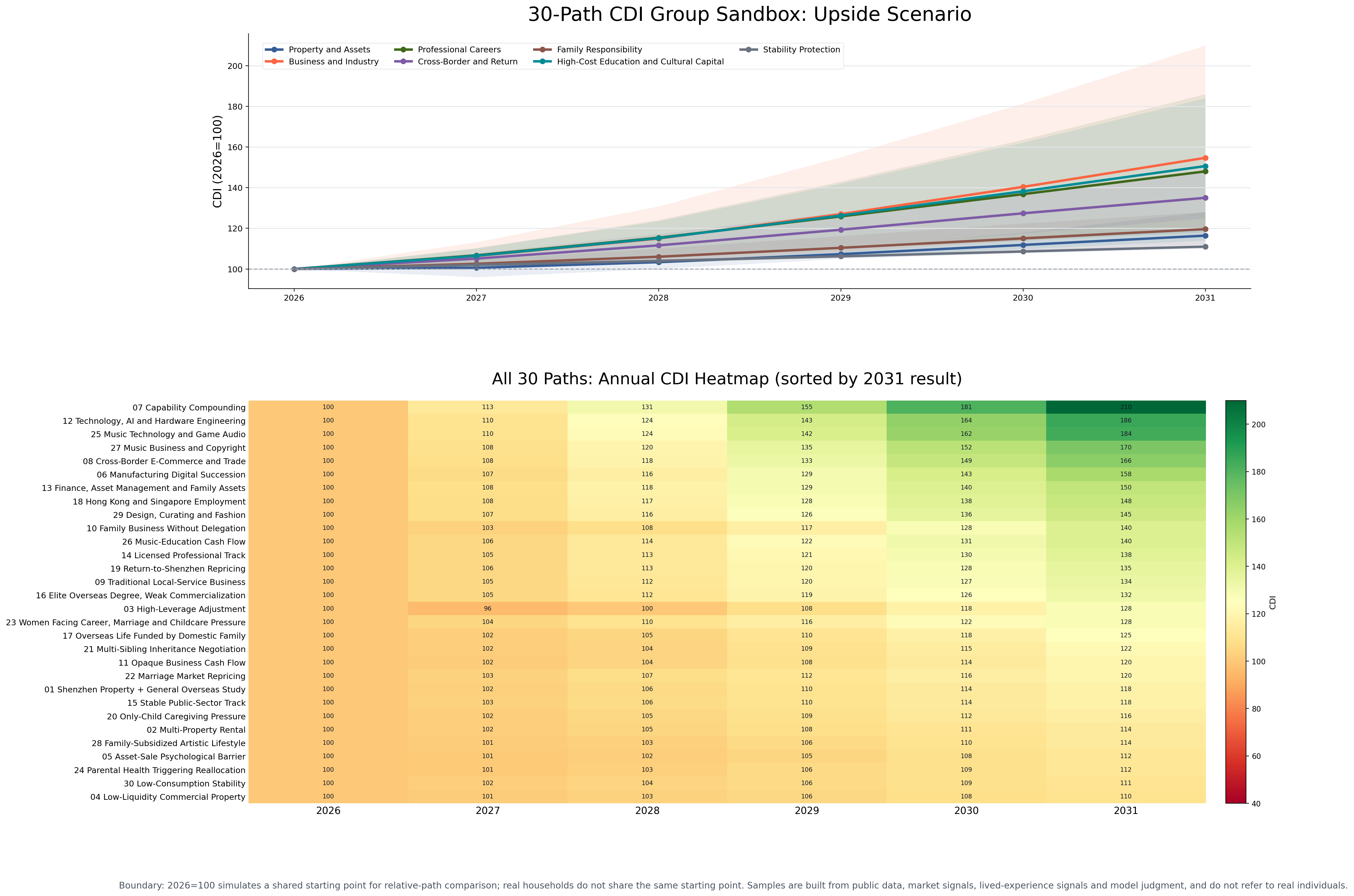
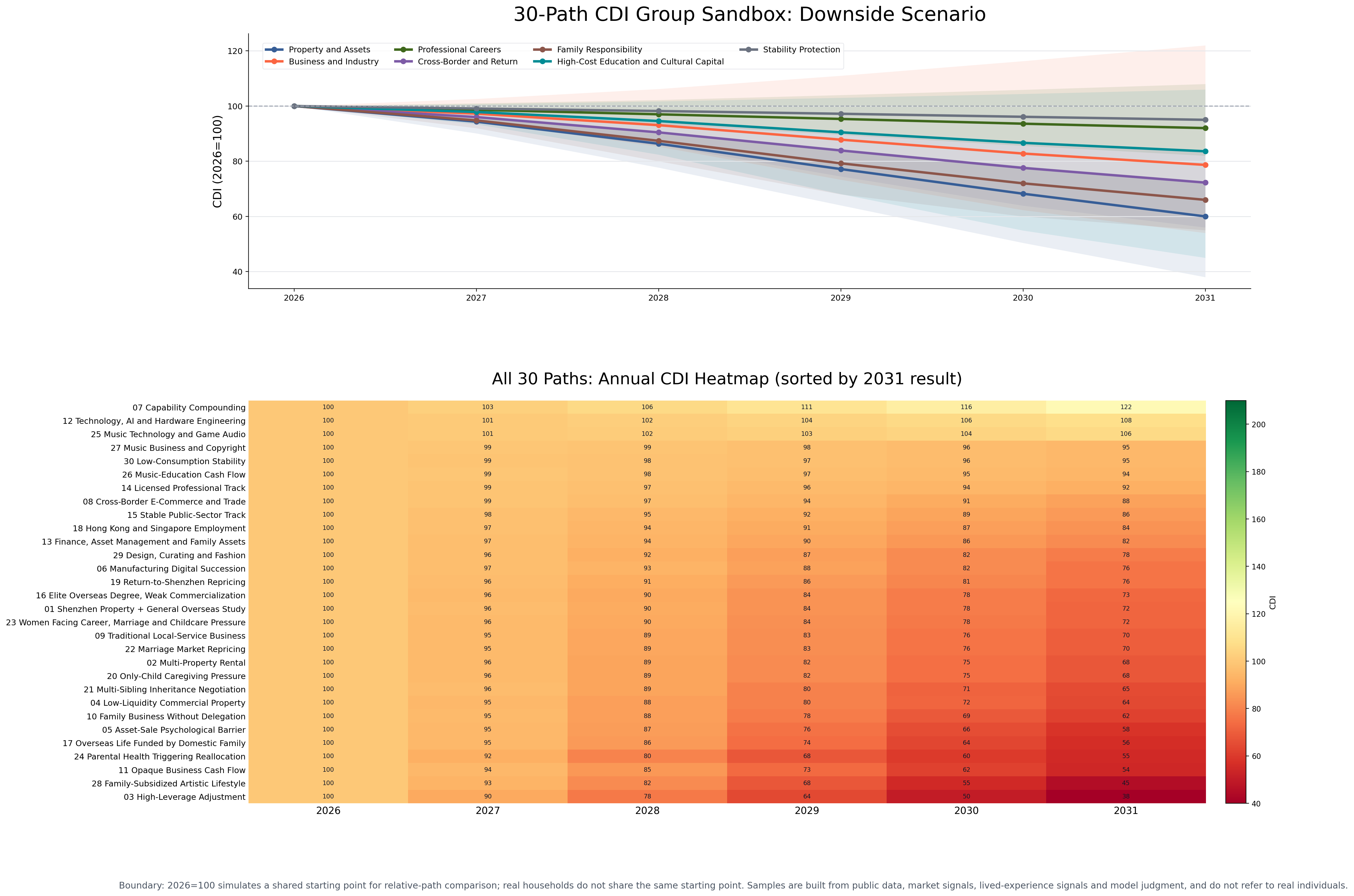
Figures 5 and 6 include all 30 paths in the same CDI sandbox. The upper panel shows group-average lines and group-level high/low ranges. The lower panel shows a 30-path annual heatmap. The charts explain mechanism divergence across capability compounding, asset pressure, industry access, family responsibility, and cultural-capital conversion. They do not represent the statistical distribution of real households and should not be used as individual diagnosis.
The model dataset places each path, year, and scenario into six dimensions while keeping evidence boundaries visible. Because we do not have real household panel data, audited household balance sheets, or cross-year career-income tracking for every path, these charts should be read as a mechanism sandbox, not as a statistical forecast, confidence interval, or causal estimate.Model judgment
Figure 5: 30-Path Upside Scenario CDI Sandbox
 Open high-resolution chart
2026=100. The 30 mechanism samples suggest faster upside growth for capability compounding, technology/AI and hardware engineering, music technology/game audio, music business/copyright, and cross-border e-commerce and trade. The difference comes from capability combinations and industry access, not from a prediction of real household returns.
Figure 6: 30-Path Downside Scenario CDI Sandbox
 Open high-resolution chart
2026=100. The 30 mechanism samples suggest stronger downside resilience for capability compounding, technology/AI and hardware engineering, music technology/game audio, music business/copyright, low-consumption stability, and education cash-flow paths. High-leverage adjustment, opaque business cash flow, family-supported artistic development, and overseas life funded mainly by domestic family cash flow face more visible pressure.
How To Read Non-Monotonic Paths
| Path | Pattern | Explanation |
|---|---|---|
| High-leverage adjustment | Falls before rising in upside scenario | Mortgage, business debt, and family decision constraints weigh on the early period. If asset prices stabilize and debt is reduced, recovery appears later |
| Asset-sale psychological barrier | Slow upside repair | Even when the environment improves, families may anchor to past prices and delay asset disposal or reallocation |
| Music technology/game audio | Can remain resilient in downside scenario | Technical music skills can connect to games, short dramas, AI audio, post-production, and outsourcing demand |
| Capability compounding | Still grows in downside scenario | Clients, skills, asset governance, and execution discipline are already present. Downside reduces slope but does not destroy the capability structure |
30 Next-Generation Development Paths
The following 30 paths are not personal stories and do not refer to real individuals. They are mechanism samples built from public data, market signals, lived-experience signals, and model inference. They help readers identify pressure structures; they do not represent statistical distribution and should not be used as individual diagnosis.
The upside, downside, and five-year split in each card show how mechanisms may work. They do not predict that any family will necessarily follow that outcome.
Property and Asset-Heavy Families
Shenzhen Property + General Overseas Study
Core judgment: The balance sheet is stronger than independent cash flow.
Upside: Property stabilization and parental support preserve a decent white-collar or light-entrepreneurial path.
Downside: Overseas-education return weakens and home-purchase support becomes more cautious.
Five-year split: Professional skill creates stability; without it, usable cash remains tight.
Multi-Property Rental
Core judgment: Rent and asset prices define lifestyle flexibility.
Upside: Property stabilization supports a low-labor lifestyle.
Downside: Rental yield, vacancy, and maintenance costs erode cash flow.
Five-year split: Active asset operation improves resilience; otherwise, asset mix may need adjustment.
High-Leverage Adjustment
Core judgment: Asset value looks large, but leverage pressure comes first.
Upside: Stabilized assets and debt reduction allow gradual repair.
Downside: Mortgages, business debt, guarantees, and cash-flow breaks compound.
Five-year split: Deleveraging restores optionality; failure lowers lifestyle and job expectations.
Low-Liquidity Commercial Property
Core judgment: Commercial property looks stable, but tenant quality and vacancy matter.
Upside: Core locations and quality tenants support family spending.
Downside: Rent cuts, vacancy, renovation, and property costs pressure cash flow.
Five-year split: Operation capability matters more than nominal ownership.
Asset-Sale Psychological Barrier
Core judgment: The pressure is not only price, but whether the family accepts repricing.
Upside: Asset-price repair gives the family more negotiation time.
Downside: Refusing to sell at a discount can make cash-flow pressure more acute.
Five-year split: Families either reallocate assets earlier or absorb larger liquidity stress later.
Business and Industrial Operation Paths
Manufacturing Digital Succession
Core judgment: Succession opportunity is real, but governance training is critical.
Upside: Digitalizing factory, clients, and supply chain creates growth.
Downside: Profit and debt pressure appear earlier.
Five-year split: The person becomes an operator, or learns succession through debt, employees, and clients.
Capability Compounding
Core judgment: This path best converts family resources into a personal curve.
Upside: Skill, clients, asset governance, and execution discipline compound together.
Downside: Downside lowers the slope but does not destroy the capability structure.
Five-year split: The person builds an independent practice or manages family assets more professionally.
Cross-Border E-Commerce and Trade
Core judgment: Opportunity sits between channels, products, and compliance.
Upside: Supply chain, platform, and brand capability combine.
Downside: Platform rules, exchange rates, tariffs, and inventory pressure test discipline.
Five-year split: The person becomes an operator, or returns to ordinary trade execution.
Traditional Local-Service Business
Core judgment: Stores, institutions, restaurants, and local services test detailed operations.
Upside: Better location, repeat purchase, and private traffic improve profit.
Downside: Rent, labor, and customer-flow decline make operating budgets more cautious.
Five-year split: Operations become standardized, or the business becomes a family cost center.
Family Business Without Delegation
Core judgment: Entering the company does not mean receiving real decision rights.
Upside: If parents open books and clients, training accelerates.
Downside: Nominal succession without authority increases conflict.
Five-year split: Either authority is clarified, or the person exits to build independent cash flow.
Opaque Business Cash Flow
Core judgment: The household may look stable while debt and receivables stay hidden.
Upside: Profit recovery still needs transparent books.
Downside: Debt, guarantees, and tax pressure can suddenly surface.
Five-year split: Transparency creates repair space; opacity increases family conflict.
Professional Career and High-Education Paths
Technology, AI and Hardware Engineering
Core judgment: Shenzhen's industrial ecosystem still rewards real technical capability.
Upside: AI, hardware, robotics, smart devices, and overseas projects create upward channels.
Downside: Generic positions face pressure, but strong portfolios retain value.
Five-year split: The person becomes a technical compounder or remains a credential holder.
Finance, Asset Management and Family Assets
Core judgment: A finance degree cannot replace risk discipline and product understanding.
Upside: Investment, insurance, allocation language, and governance tools can return to the family.
Downside: Market volatility and career contraction test judgment.
Five-year split: The person becomes useful to household governance, or stays at the level of product sales language.
Licensed Professional Track
Core judgment: Professional licensing may not create sudden wealth, but it builds social trust.
Upside: Long training, certification, and reputation create stable cash flow.
Downside: The early cycle is long and income growth may be slow.
Five-year split: Trust compounds gradually, or training costs test patience.
Stable Public-Sector Track
Core judgment: Stable employment lowers family anxiety but does not solve asset governance.
Upside: Stable income and social identity support conservative transition.
Downside: Limited salary elasticity cannot absorb major household risks alone.
Five-year split: Stability becomes a base, but additional asset literacy remains needed.
Elite Overseas Degree, Weak Commercialization
Core judgment: The school label is strong, but client capability is still missing.
Upside: Consulting, brand, finance, or cross-border service roles are possible.
Downside: Degree premium weakens and salary expectations adjust downward.
Five-year split: Professional evidence creates a decent path; without it, cash flow remains weak.
Cross-Border, Identity and Return Paths
Overseas Life Funded by Domestic Family
Core judgment: Lifestyle quality may be good, but cash-flow source and responsibility location can mismatch.
Upside: Stable family support allows language, career, and network accumulation abroad.
Downside: Exchange rates, living costs, parental health, and domestic cash flow make the model fragile.
Five-year split: The person either builds local income, or returns under pressure.
Hong Kong and Singapore Employment
Core judgment: Regional platforms offer opportunity, but competition is international.
Upside: Finance, technology, professional services, and cross-border work create income steps.
Downside: Visa, housing, industry cycles, and living costs raise pressure.
Five-year split: The person becomes a regional professional or returns with recalibrated expectations.
Return-to-Shenzhen Repricing
Core judgment: After returning, school labels are repriced by jobs, clients, and projects.
Upside: Cross-cultural communication, industry understanding, and delivery capability are valued.
Downside: Salary expectations and lifestyle costs must adjust.
Five-year split: The person becomes useful in cross-border work, or experiences a prolonged identity reset.
Marriage, Caregiving and Inheritance Pressure Paths
Only-Child Caregiving Pressure
Core judgment: Parental health can turn free choice into family responsibility earlier than expected.
Upside: Insurance, medical plans, caregiving arrangements, and distance planning reduce shock.
Downside: Sudden illness disrupts work, overseas life, and marriage choices.
Five-year split: Early planning protects options; late planning compresses them.
Multi-Sibling Inheritance Negotiation
Core judgment: As assets and responsibilities become more complex, allocation expectations need earlier clarity.
Upside: Parents define rules and siblings take differentiated roles.
Downside: Property, equity, and caregiving obligations intertwine.
Five-year split: Transparent rules reduce relationship cost; ambiguity increases conflict.
Marriage Market Repricing
Core judgment: Marriage judgments shift from school and family label toward cash flow, liabilities, and parental health.
Upside: Stable work and clear family boundaries improve match quality.
Downside: Hidden debt, no independent income, or unclear caregiving roles reduce attractiveness.
Five-year split: Transparent responsibility becomes a trust signal.
Women Facing Career, Marriage and Childcare Pressure
Core judgment: Strong education does not automatically offset career, marriage, and caregiving pressure.
Upside: Professional skill, family support, and partner negotiation form a stable combination.
Downside: Career interruption, childcare, and parental care can stack together.
Five-year split: The path depends on negotiation quality and cash-flow independence.
Parental Health Triggering Reallocation
Core judgment: Health events can force asset, residence, caregiving, and business-power questions into one frame.
Upside: Authorization, insurance, and medical arrangements make shock manageable.
Downside: Without a plan, younger members may face decisions before they are ready.
Five-year split: Prepared families turn shock into reorganization; unprepared families face conflict.
Art, Content and High-Cost Education Paths
Music Technology and Game Audio
Core judgment: This is one of the clearest routes for turning music training into cash flow.
Upside: DAW, sound design, game audio, and AI workflows scale.
Downside: Outsourcing, games, short dramas, and ad audio may still create demand.
Five-year split: The person becomes a technical creative-service provider or enters Shenzhen's digital-content ecosystem.
Music-Education Cash Flow
Core judgment: The ceiling is limited, but cash flow can be stable.
Upside: International schools, institutions, private lessons, and children's education support demand.
Downside: Parent willingness to pay weakens, but core education demand remains resilient.
Five-year split: Recruitment and curriculum systems create stability; otherwise income depends on hourly fees.
Music Business and Copyright
Core judgment: This is closer to industry cash flow than performance.
Upside: Labels, publishers, IP, live events, and data operations expand opportunities.
Downside: Contracts, clients, and platform understanding define resilience.
Five-year split: The person becomes a music-industry business talent or shifts into brand/IP operations.
Family-Supported Artistic Development
Core judgment: Cultural experience is strong, but commercialization capability still needs work.
Upside: When family support is stable, art, social life, and light entrepreneurship can continue.
Downside: When household cash flow weakens, self-support capacity is tested.
Five-year split: The path becomes a commercial project, or the lifestyle radius narrows.
Design, Curating and Fashion
Core judgment: Aesthetic training has value, but it must connect to brands, spaces, content, or consumption scenes.
Upside: Shenzhen and Hong Kong provide openings in brand, exhibition, commercial space, and content projects.
Downside: Project budgets shrink and competition rises.
Five-year split: The person becomes a brand-service provider, or remains dependent on family support.
Low-Consumption Stability
Core judgment: Growth may not be high, but resilience is strong.
Upside: Controlled spending, stable work, and fewer distractions preserve the base.
Downside: In downside conditions, fewer mistakes preserve optionality.
Five-year split: The lifestyle is not flashy, but it can protect long-term choices.
Seven Practical Constraints
This public report does not turn these constraints into a family self-test or set income thresholds. The more important task is to understand which mechanisms reprice safety, freedom, and decision boundaries when the environment changes.
Cash flow reprices asset comfort
Net worth gives balance-sheet comfort. Cash flow gives life sustainability. Families will more often separate "having assets" from "having usable resources."
Liquidity reprices property comfort
Property remains central, but transaction cycle, rental quality, mortgage capacity, and willingness to sell determine whether it is a cushion or a low-liquidity burden.
Business pressure reprices succession
Succession is not only about whether there is a business to inherit. Orders, receivables, employees, tax, clients, and parental delegation define the real path.
The job market reprices degrees
Degrees still signal quality, but they increasingly need to be paired with portfolios, projects, internships, credentials, clients, or organizational experience.
Caregiving reprices freedom
As parents enter ages 50-70, health, care, authorization, medical decisions, and living distance reshape overseas life, work, and entrepreneurship choices.
Marriage markets reprice family background
Family background still matters, but long-term matching increasingly looks at personal cash flow, liability transparency, parental health, housing, and boundaries.
Cultural capital reprices high-cost education
Music, art, design, content, and elite-school experience can be valuable, but only if they connect to clients, projects, teaching, copyright, tools, brands, or family industry.
High-Cost Education and Cultural Capital: Music and Art as an Example
High-cost education is not a pure education investment. For many asset-holding urban households, it includes cultural experience, capability training, social environment, and personal narrative. The practical question is how these gains turn into works, clients, teaching, projects, copyright, technical tools, or industry access after graduation.
Figure 7: Monetization Entrances for High-Cost Education
Technical Creative Services
Conversion: Game audio, sound design, AI workflow, post-production, advertising, and short-drama projects.
Test: Can the work be used by clients, not only appreciated by peers?
Education and Course Products
Conversion: International schools, institutions, private lessons, portfolios, children's education, and adult interest education.
Test: Recruitment, renewal, reputation, and curriculum standardization.
Copyright Business and IP
Conversion: Rights management, artist management, live events, brand licensing, and platform operations.
Test: Contracts, data, negotiation, and platform understanding.
Performance and Content Platforms
Conversion: Performances, livestreaming, short video, hosting, performance training, and branded content.
Test: Continuous content output, agency access, resilience, and cost discipline.
Design, Curating and Brand Services
Conversion: Commercial space, exhibitions, fashion, visual content, brand events, and consumer projects.
Test: Can aesthetic skill become budget, clients, and delivery process?
Family-Industry Integration
Conversion: Brand content, store experience, corporate showroom, education institution, cultural space, and client events.
Test: Can cultural capital become a real service capability inside family industry resources?
Fee assessment should use school pages. For Chinese families, the real calculation is cost of attendance + exchange rate + holiday travel + equipment + portfolio + living support for the first 0-3 years after graduation, not tuition alone.Berklee Cost of Attendance, Juilliard Tuition and Expenses, Royal Academy of Music Fees, Guildhall Fee ScheduleSchool dataModel judgment
Employment outcomes should not be read only from school marketing. Berklee’s Early Career Outcomes and the UK’s HESA Graduate Outcomes help identify industry distribution, but arts careers are highly project-based. Public statistics rarely show family support, part-time teaching, project cash flow, or psychological transition costs.Berklee Early Career Outcomes, HESA Graduate OutcomesEmployment dataModel judgment
The core judgment is this: if cultural training connects to clients, projects, technical tools, education products, copyright contracts, or family industry, it can become high-quality cultural capital. If it stays disconnected from these systems, its economic return becomes more uncertain. This judgment comes from school fees, employment outcomes, market signals, and model inference. It is not a return promise for any school or major.School dataEmployment dataMarket signalsModel judgment
Why This Is Public Flagship Research
Public flagship research does not decide for readers. It shows a judgment language that can be discussed, reviewed, and deepened. For Taiwha, this report does three things:
Research quality
It places macro data, household asset structure, education return, career change, and family responsibility in one explanatory framework.
Boundary awareness
It separates facts, market signals, lived-experience signals, and model judgment. It does not package scenario analysis as certainty.
Extensibility
For more specific family, market, or organizational questions, the framework can extend into commissioned research, decision briefs, scenario stress tests, or report updates.
This is why public research can become a trust entrance: readers first see method, evidence boundaries, and judgment style, then decide whether a more specific question deserves structured report work.
How To Keep Reading and Watching
This report is best read as a discussion framework, not as an operating checklist. Readers can continue with three questions:
- Is the family balance sheet being reinterpreted from nominal assets into cash flow and responsibility?
- Can the younger family member’s education, career, and life choices produce verifiable capability rather than only preserve a personal narrative?
- Are parental health, business operation, property liquidity, and marriage boundaries becoming new topics of family negotiation?
What To Watch Over the Next 12-24 Months
| Signal | Why it matters |
|---|---|
| Whether Shenzhen technology manufacturing and software services keep growing faster than real estate | Determines opportunity density for skill-based paths |
| GBA property transactions and rents | Determines property-heavy family cash flow and collateral capacity |
| Private manufacturing profit and orders | Determines whether succession paths face expansion or repair |
| Jobs in game audio, short-drama post-production, copyright business, design/curating, and course products | Determines whether high-cost cultural education can become productive capability |
| Whether families begin cutting overseas budgets and living allowances | Early signal of life changes for younger family members |
| Whether parents start asking children to return, join the business, date/marry, buy property, or end a gap year | Signal that family control is tightening |
Key Takeaways
- For asset-holding urban households, the most important five-year task may not be expanding asset scale again, but re-reading the balance sheet as cash flow, liabilities, skill, and governance.
- For younger family members, the key task is not proving total independence from family resources. It is proving that existing resources can become replicable capability.
- For high-cost education families, the key question is not whether the school is prestigious enough. It is whether the graduate has clients, projects, credentials, teaching products, technical tools, or copyright/business access within three years.
More specific family, market, or organizational questions can continue through structured report work: see how report products can support more specific questions.
Sources and Notes
The sources below should be read as official-entry references. Some websites may show automated access issues due to migration, regional access, SSL, or anti-bot settings. When readers verify or update the judgment later, the institution’s latest official website entry should be used rather than unofficial secondary sources.
- National Bureau of Statistics: 2026 Q1 national economic performance
- Shenzhen Statistics Bureau: 2026 Q1 Shenzhen economic performance
- Greater Bay Area official portal: Overview
- IMF: World Economic Outlook
- OECD: China Economic Snapshot
- Hurun: Public wealth report materials
- Berklee: Cost of Attendance and Early Career Outcomes
- Juilliard: Tuition, Fees and Expenses
- Royal Academy of Music: Fees and Funding
- Guildhall School: Fee Schedule
- HESA: Graduate Outcomes Survey Results