
- Report type: Think Tank Observation Report
- Coverage: selected advanced-manufacturing nodes in Shenzhen Guangming, Dongguan Binhaiwan and Songshan Lake
- Evidence cutoff: 30 June 2026
- Sources last checked: 27 July 2026
This report follows four projects at different stages: Dongkeng Semiconductor Industrial Park in Guangming District, Shenzhen; the Tongke subproject inside Lingxigu in Dongguan Binhaiwan; Huaxia Hengtai R&D and Production Headquarters in Dongguan Songshan Lake; and Putailai’s South China Regional Headquarters for lithium-battery automation equipment.
The report asks how far each project has progressed, which developments are supported by public records, and which still need delivery, equipment or operating information. It does not rank the projects.
Main findings
What the evidence currently shows
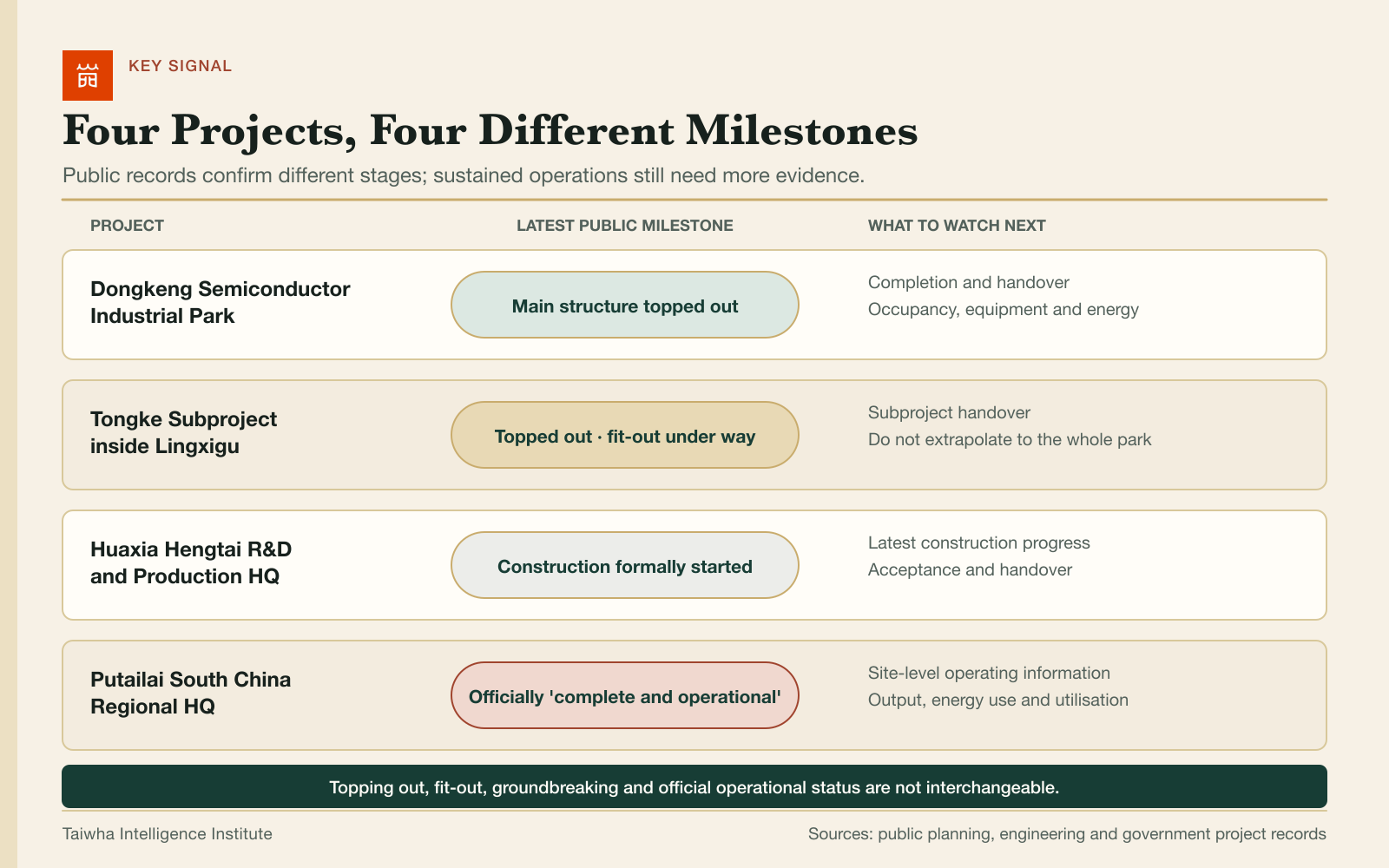
All four projects have recorded new progress beyond planning, but they are at different stages. Some have topped out, one has entered fit-out, one has formally started construction, and one has been officially described as “completed and operational”. The evidence suggests that selected advanced-manufacturing projects in the Shenzhen–Dongguan section are entering substantive construction or operating-readiness stages. More information is still needed to determine whether they have been handed over and reached stable production.
Confidence in the conclusion
Moderate. Government or project records support the project identities and some construction milestones. Comparable information on handover, equipment operation, site-level output, utilisation and sustained activity remains limited. Taiwha internal satellite data adds observations of surface change but cannot establish a construction or production stage by itself.
The three developments that matter next
The next question is whether the projects move through three successive stages:
- from a completed structure to acceptance and handover;
- from handover to equipment, recruitment and operating readiness;
- from an “operational” label to a sustained and observable level of activity.
What new information would change the conclusion
The conclusion would be revisited if official records changed a project’s identity or construction status. New completion, handover, equipment, energy-use or site-level operating information would also require an update.
Observation question and evidence scope
Core question
This report answers:
As of the evidence cutoff, how far have planning, construction, handover readiness and operating signals progressed for selected advanced-manufacturing projects in the Shenzhen–Dongguan section?
This report does not answer:
- whether company revenue, profit or orders are growing;
- whether a particular factory is operating at full capacity;
- whether project returns have met expectations;
- whether industrial-park investment promotion or local policy has “succeeded”;
- whether a surface change at a particular location was caused by a specific project.
Why this is worth observing now
The four projects are entering stages that are easy to conflate. Topping out, fit-out, formal groundbreaking, and “completed and operational” are all closer to physical implementation than planning. Each, however, describes a different type of progress. Over the next one to two years, several planned milestones are expected to move towards handover or completion. Separating these stages is necessary to see how far each project has actually progressed.
For industry observers, equipment suppliers, park operators and manufacturers, the next source of value is not another confirmation that a project exists. It is evidence of when a project enters acceptance, equipment installation, energy connection, recruitment and sustained operation.
Evidence scope
The report uses five types of evidence:
- planning, natural-resources and land records;
- engineering, permit, specialist acceptance and government project-progress records;
- public company, regulatory and operating-entity signals;
- Taiwha internal satellite data;
- delivery and sustained-operating information that has not yet been obtained.
Project progress is divided into five stages:
| Stage | Main question | Typical evidence |
|---|---|---|
| Planning and land | Who is the project, where is it, and what is planned? | Planning permission, land notices and project lists |
| Physical construction | Are there documented construction milestones? | Groundbreaking, foundations, main structure, roads and supporting works |
| Handover and acceptance | Is the project ready to be transferred and used? | Completion, fire-safety and specialist acceptance, and handover |
| Operating readiness | Is operating capacity being assembled? | Equipment, recruitment, energy connection and precise-address entities |
| Sustained operation | Is there observable, sustained activity? | Output, utilisation, orders, energy use or revenue |
Evidence from one stage cannot substitute directly for progress at the next. A lack of public information also does not mean that no real activity exists.
What has changed in the physical and project record
Progress shown in public records
| Case | Latest public progress | What can currently be established | What remains to be learned |
|---|---|---|---|
| Dongkeng Semiconductor Industrial Park | The Guangming District government recorded that the main structure had fully topped out. The public plan still places handover in the second quarter of 2027; a permanent-access-road matter was also recorded in 2026 | The project has entered follow-on construction and supporting works after completion of the main structure | Handover, company occupancy, equipment operation or sustained production |
| Tongke subproject inside Lingxigu | A public report records that the roughly 20-mu subproject had topped out and entered fit-out | The subproject has formed its main structure and continued into fit-out | The stage of the wider roughly 370-mu park, or the status of other parcels |
| Huaxia Hengtai R&D and Production Headquarters | The Dongguan Development and Reform Bureau recorded that construction began in September 2025, with completion and operation expected in 2027 | The project has moved beyond planning and has an official groundbreaking baseline | Current on-site stage, completion and handover, equipment entry and sustained operation |
| Putailai South China Regional Headquarters for lithium-battery automation equipment | The Songshan Lake Administrative Committee stated that the project was completed and operational in March 2025. Specialist filing and operating-entity records provide additional signals | The official progress chain and operating-entity identity are relatively clear | Independent output, equipment operating rate, orders, energy use or utilisation |
All four projects show actual progress beyond planning. Their principal difference lies in what comes next: some need handover evidence, some need evidence of equipment entering the site, and one needs sustained-operating information.
Additional observations from internal satellite data
What Taiwha internal satellite data shows
The report uses Taiwha internal satellite data to observe surface changes across three anonymous areas over multiple periods. The results describe signals within each area and do not correspond to the order of projects in the main text.
| Anonymous area | Multi-period observation | What it can currently show | What it cannot currently show |
|---|---|---|---|
| Area A | Surface differences appear across multiple observation periods | The selected area was not completely static | Whether the changes came from construction, landscaping or a specific project |
| Area B | Overall change was relatively limited, but the area was not entirely unchanged | Differences were weaker during the observation period | Whether construction was absent, had stalled or had already finished |
| Area C | Differences were more visible in the later observation interval | Surface signals changed more strongly during one stage | Whether a project was building faster, accelerating or already operating |
The three areas do not correspond sequentially to the four projects discussed in the report.
Key signal dashboard
What is currently visible
| Signal | Current state | Evidence type | Confidence | Explanation |
|---|---|---|---|---|
| All four projects have records beyond the planning stage | Present | Observed | Medium-high | Project information has moved into more concrete stages, although the stages differ |
| Dongkeng and Tongke have main-structure milestones | Present | Observed | Medium-high | Public records show completed structural milestones; handover and operation still need confirmation |
| Huaxia Hengtai has a formal groundbreaking record | Present | Observed | Moderate | Construction has begun; the latest on-site stage still needs an update |
| Putailai has an official operational label | Present | Observed | Moderate | Official progress is relatively clear; sustained operation remains to be established |
| Three anonymous areas show different degrees of surface change | Present | Observed | Moderate | Taiwha internal satellite data provides a supplement to project records |
| The projects are forming sustained production capacity | Not established | Preliminary inference | Low | Equipment, energy use, output, utilisation or order information is needed |
| Regional advanced-manufacturing activity is strengthening on a sustained basis | Not established | Preliminary inference | Low | The sample is limited and comparable operating data is missing |
The evidence currently establishes project records and some construction milestones. Sustained capacity and region-wide strengthening still need more operating information.
Scope and limits of the satellite observations
How the data is used in this report
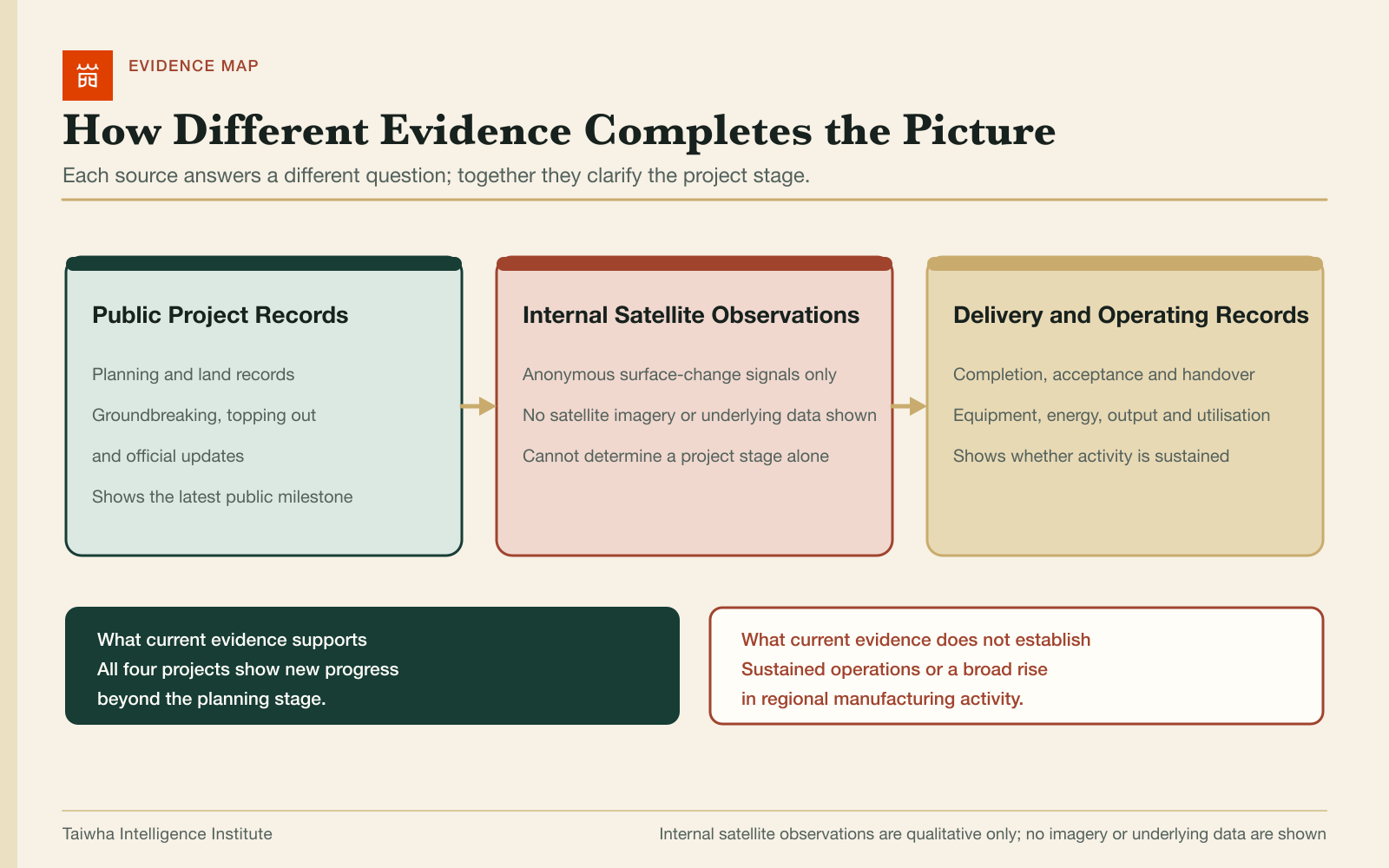
Taiwha internal satellite data is used to compare the same area across multiple observation periods. It adds a physical perspective to public project records.
Satellite data records surface signals. It does not contain construction permits, completion acceptance, equipment-installation status or production status. It therefore cannot independently establish formal groundbreaking, topping out, construction delays, building acceptance, equipment entry or company operation.
The same observed area may contain roofs, roads, vegetation, shadows and bare ground. Seasonal conditions, materials, weather and changes to the observation area may all affect the surface signal.
In this report, satellite observations supplement public project records and do not determine a project stage by themselves.
How the different sources support one another
Engineering, operating and satellite records answer different questions
| Current information | Follow-up evidence | What it would clarify |
|---|---|---|
| Main structure topped out | Completion, fire-safety, specialist acceptance and handover records | Whether the building is ready for transfer and use |
| Fit-out under way | Equipment procurement and installation, energy connection and recruitment | Whether the project is preparing for actual operation |
| Officially completed and operational | Site-level output, energy use, utilisation or orders | Whether the project has sustained operation |
| Differences in internal satellite data | Authoritative boundaries and on-site or engineering records | Whether a surface change is related to a particular project |
| Limited change in internal satellite data | A longer observation period and other first-hand records | Whether the change is small or the observation window is simply too short |
Satellite records provide clues about physical change, engineering records describe construction progress, and operating records indicate whether a project has entered actual use. The project stage becomes clearer when the three types of information point in the same direction.
Why the same word, “progress”, can describe different realities
The following sections address specific questions. Each explanation sets out supporting evidence, other possibilities, the current level of support, Taiwha’s interpretation, and what to watch next.
Why topping out still requires further evidence
Topping out establishes only that a building’s structure has reached an engineering milestone. Mechanical and electrical work, fire safety, specialist acceptance, handover, occupancy and equipment installation may all be completed at different times.
- Supporting evidence: Both Dongkeng and Tongke have structural-milestone records, while public sources still describe handover or fit-out as the next stage.
- Other considerations: If new completion, handover or equipment records already exist but are not yet captured here, actual progress may be further advanced.
- Current level of support: Relatively high. The main structures can be established, but later use still needs more evidence.
- Taiwha interpretation: Topping out is meaningful physical progress, but it is not a synonym for operating capacity.
- What to watch next: Completion acceptance, handover, occupancy and equipment entry.
Why an operational label is not the same as sustained operation
“Completed and operational” usually establishes that a project has reached an official or company-stated operating milestone. Sustained operation still involves output, energy use, equipment utilisation, orders and continuity over time.
- Supporting evidence: The Putailai project has an official “completed and operational” label and operating-entity signals, but no public site-level measure of sustained operation.
- Other considerations: Operating data may be commercially private. The absence of public data does not mean that no real production exists.
- Current level of support: Relatively high. The evidence shows that a further observation interval remains between the official milestone and sustained-operating information.
- Taiwha interpretation: For companies and industrial-service providers, sustained activity changes the commercial picture more than a milestone label alone.
- What to watch next: Continuous site-level energy use, output, utilisation, recruitment and regulatory records.
Why planned milestones can change during implementation
Construction projects often proceed through annual plans, financing, permits, construction sequencing and phased development. Plans in different years may emphasise different milestones.
- Supporting evidence: The case materials contain planned handover, expected completion and staged engineering records whose timing is not fully aligned.
- Other considerations: Without a single authoritative baseline schedule, not every change in timing can be treated as routine adjustment.
- Current level of support: Moderate. The explanation can account for some timing differences, but each one still needs to be checked separately.
- Taiwha interpretation: A milestone change is not inherently positive or negative. What matters is whether new records explain it and whether the project continues into the next stage.
- What to watch next: Authoritative progress schedules, contract milestones and explanations of plan revisions.
Why a park, a land parcel and a subproject are not interchangeable
The same industrial park may contain multiple parcels and subprojects with different stages, entities and uses. Topping out at one subproject cannot be extrapolated to simultaneous completion across the whole park.
- Supporting evidence: Public Tongke records concern a roughly 20-mu subproject inside Lingxigu, while park records describe a much larger area.
- Other considerations: Parcel-by-parcel engineering records would clarify the status of the wider park.
- Current level of support: Relatively high. This distinction is necessary to avoid presenting subproject progress as whole-park progress.
- Taiwha interpretation: When the geographic scale is wrong, an accurate point fact can still become an inaccurate overall conclusion.
- What to watch next: Authoritative parcel boundaries, construction permits and project-by-project progress.
Why short-term surface change may reflect temporary conditions
Changes in internal satellite data may come from construction, but they may also reflect seasons, materials, shadows, temporary storage, maintenance or observation conditions. Limited change may likewise reflect a short observation window.
- Supporting evidence: The three anonymous areas show different multi-period patterns, but the current information cannot consistently associate those differences with a particular project stage.
- Other considerations: If authoritative boundaries, on-site records and a longer observation period continue to point in the same direction, temporary conditions become a less likely explanation.
- Current level of support: A possibility that should remain under consideration.
- Taiwha interpretation: Seeing change starts the investigation; it does not finish it.
- What to watch next: New observation periods, authoritative boundaries, and on-site or engineering records.
Comparing the explanations
| Explanation | Current level of support | Principal basis | What still needs confirmation |
|---|---|---|---|
| Engineering progress continues in stages | Relatively high | Topping out, fit-out and later handover milestones coexist | The latest acceptance records may be missing |
| Official operational status and sustained-operating measures remain separate | Relatively high | The official label is clear; site-level operating measures are absent | Public records cannot capture private operating activity |
| Plans and phasing change over time | Moderate | Several planned milestones and staged records coexist | There is no single baseline schedule |
| Park and subproject scales differ | Relatively high | The Tongke subproject and wider Lingxigu park cover different areas | Parcel-level records remain incomplete |
| Short-term change or observation conditions | Keep under consideration | Differences among anonymous areas cannot yet be linked to specific projects | A longer observation period may reduce this possibility |
The report does not assign percentages. The four projects are observed through different evidence, and the satellite results are presented anonymously. Exact shares would make the result appear more certain than the evidence allows. “Relatively high”, “moderate” and “keep under consideration” describe how closely the current evidence fits each explanation.
Taiwha synthesis
Taken together, the evidence shows that all four projects have made new progress beyond planning. Topping out, fit-out, formal groundbreaking, and an official “completed and operational” status describe different stages. Evidence about a park, parcel or subproject also cannot substitute for one another. Selected advanced-manufacturing projects in the Shenzhen–Dongguan section are entering more concrete construction and operating-readiness stages, but their pace and the completeness of available records vary. The evidence does not yet establish sustained operation across all four projects. Nor does it show a broad rise in regional manufacturing orders or capacity utilisation. The anonymous satellite observations cannot be assigned to individual projects and are not suitable for comparing their relative performance. The next material question is whether topping out, fit-out and official operational milestones lead to handover, equipment entry, energy use and sustained-operating information.
Terminology
- Topping out: A structural engineering milestone, not completion or handover.
- Completed and operational: A stage description used by the source; it does not automatically mean sustained output.
- Internal satellite data: Taiwha internal information used to supplement observations of physical change. It cannot replace engineering, operating or on-site information.
- Current level of support: How closely existing evidence fits an explanation, not a precise calculation.
- Confidence: The reliability of a conclusion given evidence quality, coverage and other possibilities.
- Not established: The current evidence is insufficient for a conclusion; it does not mean that reality must be the opposite.
Who can use this observation
Implications for different readers
| Reader | Most relevant question | What this report provides |
|---|---|---|
| Manufacturers and supply-chain leaders | When will upstream or downstream projects enter genuine operating readiness? | A distinction among engineering milestones, handover and sustained operation |
| Equipment and industrial-service providers | Which projects may be approaching equipment, energy or installation stages? | Next-stage milestones and an observation list |
| Park and local industry organisations | How can staged progress be presented constructively? | Project-stage language that avoids overstatement |
| Industrial real-estate and logistics organisations | Which milestones may create future space or logistics demand? | Public engineering progress and project conditions that still need confirmation |
| Investment and research organisations | How much real-world support exists for company and regional narratives? | Sources, competing possibilities and the next evidence to watch |
Business implications
The current evidence is best used to set observation priorities, not as a direct basis for investment, procurement or site-selection decisions. The developments that matter most to commercial readers include:
- whether handover begins to create equipment, energy and recruitment demand;
- whether an official operational label is followed by sustained-operating measures;
- whether subproject progress spreads to other parcels in a park;
- whether different sources begin to support the same address, project and stage.
Three possible development paths
| Path | Possible process | What to watch | When the interpretation would need to change |
|---|---|---|---|
| Base path: phased progress | Projects continue from construction towards handover and operating readiness | Acceptance, handover, equipment and recruitment appear gradually | Material milestones remain absent for an extended period, or plans change substantially |
| Faster path: several sources point in the same direction | Engineering, company, regulatory and internal satellite observations continue to align | Energy use, output or utilisation appears after handover | New records show that the project entity, address or stage is inconsistent |
| Slower path: observed change mainly reflects the period or reporting convention | Public milestones do not progress and satellite differences cannot be linked to project stages | Plans are repeated while material new progress remains limited | Continuous first-hand operating information begins to appear |
Possible next research paths
Cautious path
Continue updating the four cases against the five project stages, and change the conclusion only when material new progress appears.
Focused path
Add topic-specific tracking of equipment, energy, recruitment or precise addresses for one customer type, while retaining an observational conclusion.
Experimental path
Once authoritative boundaries are available, design a public-safe pilot for long-term physical-change tracking at one project. Any pilot should first define cost, stopping conditions and the public boundary.
These are research-product design options, not recommendations for action by any company.
Primary customer type
This foundation report is most relevant to organisations that need to judge when advanced-manufacturing projects move from construction into operating readiness. These organisations lack complete on-site data and may include manufacturers, industrial-service providers, park operators, logistics and industrial real-estate organisations, and industry-research teams.
For this audience, the three most important signals are:
- whether handover and acceptance have actually occurred;
- whether equipment, energy and recruitment are tied to a precise address;
- whether an official operational label is followed by sustained-operating measures.
How a company-specific relevance page could be added
For a particular organisation, only one or two light-touch pages should be added:
- which project stage or industrial node is relevant to the organisation;
- which two signals may affect its assessment;
- what information is still missing;
- one low-cost, reversible confirmation step;
- what result would stop further research.
The public foundation report contains no named client, client data or account-level recommendation.
What is already relatively clear
How far the evidence currently reaches
| What can currently be established | What can be observed cautiously | What cannot currently be established |
|---|---|---|
| Project identity and selected land and engineering milestones | Projects are moving from planning towards more concrete stages | Company revenue, orders, profit or capacity utilisation |
| Official sources use topping-out, groundbreaking, or completed-and-operational language | Different projects require different next evidence | All four projects are at the same stage |
| Anonymous surface differences exist in internal satellite data | Some areas merit higher research priority | A specific project caused the surface differences |
| The park and subprojects differ in scope | Parcel-level records would clarify project correspondence | The whole park and a subproject are progressing in step |
Five common misreadings are:
- treating topping out as handover or operation;
- presenting a subproject’s stage as the stage of an entire park;
- treating an official operational label as an independent measure of operation;
- treating missing public records as proof that no real activity exists;
- treating differences in internal satellite data as a construction classification.
What new information would change the current conclusion
| Current conclusion | Evidence that would clarify the situation | Conditions that would require reassessment |
|---|---|---|
| Dongkeng is in a post-structure construction stage | Completion, handover, occupancy, equipment or energy records | Corrections to project identity, plans or principal engineering sources |
| The Tongke subproject and the wider Lingxigu park must be treated separately | Authoritative park and subproject boundaries and parcel-level engineering records | Evidence that the current records describe another project |
| Huaxia Hengtai has an official groundbreaking baseline | Latest construction, acceptance, handover or precise-address company records | Material changes to the project land or construction entity |
| Putailai has a relatively strong official operational label | Site-level equipment, energy, output or utilisation | Official or regulatory updates that change the project identity or stage |
| Internal satellite data remains descriptive only | Authoritative boundaries and on-site or engineering records | Later evidence showing that the current satellite-observation areas are not applicable |
Ongoing observation plan
Project progress to watch next
| Subject | What to watch next | Principal sources | What the information would clarify |
|---|---|---|---|
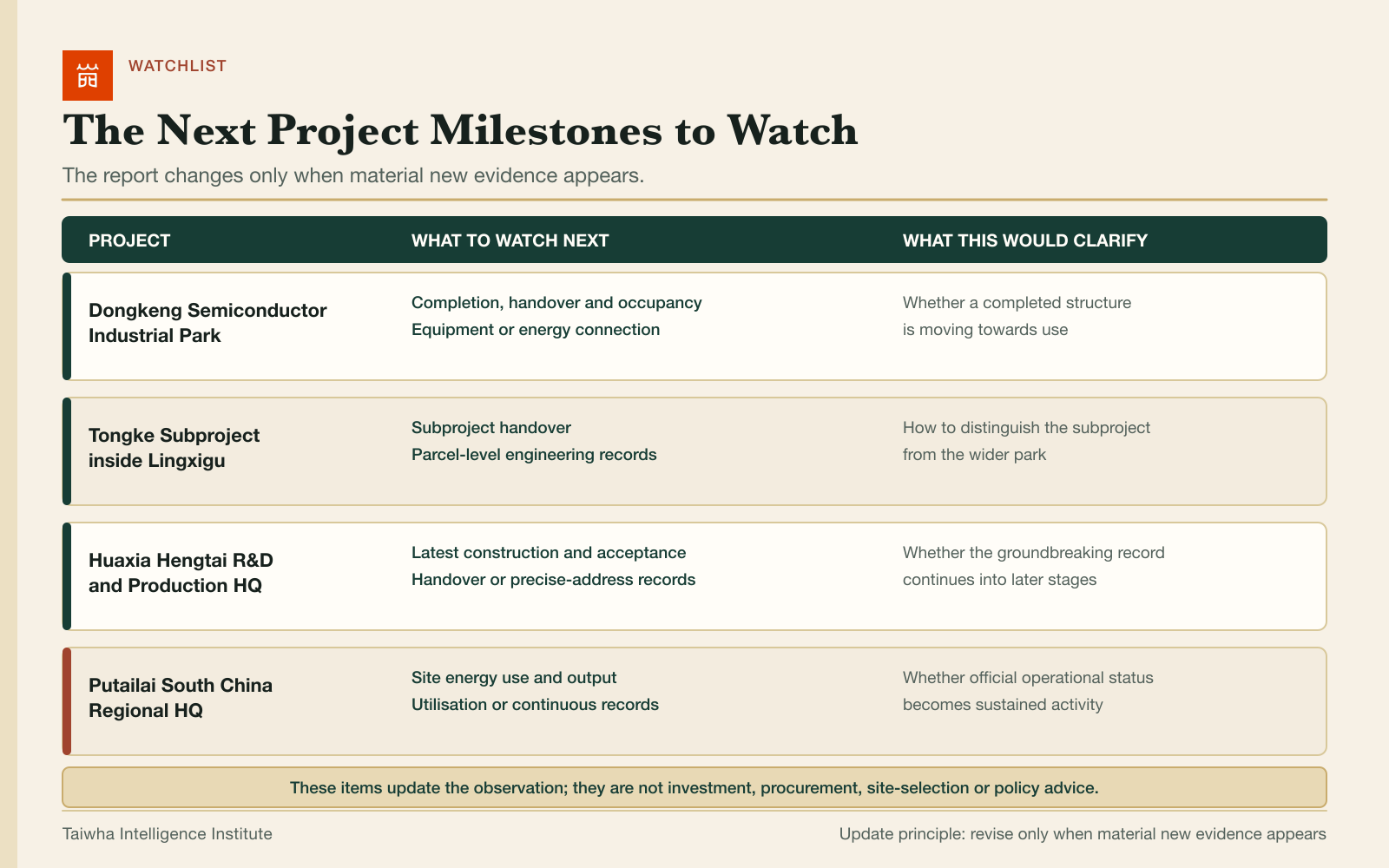
| Dongkeng Semiconductor Industrial Park | Completion, handover, occupancy, fire-safety or specialist acceptance | Government permits and records from construction and operating entities | Whether the project is moving from construction into handover and operating readiness |
| Lingxigu and the Tongke subproject | Authoritative boundaries, construction permits, completion acceptance and equipment procurement | Natural-resources, housing and construction, company and tender records | Whether subproject progress can be described separately from other parts of the park |
| Huaxia Hengtai | Latest construction stage, project address, handover and equipment entry | Development and reform, natural-resources, housing and construction, and company records | How far the project has progressed after formal groundbreaking |
| Putailai and Jiatuo | Energy, equipment, output, utilisation and later regulatory information | Company, regulatory, energy and environmental records | Whether the official operational label is followed by sustained operation |
| Internal satellite observations | New observation periods and authoritative boundaries | Taiwha internal satellite data and authoritative boundary records | Whether surface changes continue and can be associated with a specific project |
When the report will change
This report changes when material new progress appears; it does not follow a fixed monthly schedule. The relevant conclusions will be revisited if any of the following occurs:
- new evidence shows that a project has been handed over or entered operation;
- official sources revise a project’s identity, plan or stage;
- project boundaries receive authoritative confirmation;
- continuous site-level energy, equipment, output or utilisation information begins to appear;
- new internal satellite observations align or conflict with first-hand engineering records;
- the existing direction of change reverses materially.
If there is no material new progress, repeated republication of the same plan would not, by itself, change the report’s conclusion.
Method, sources, statement and closing
Method
Project facts prioritise public planning, natural-resources, development and reform, housing and construction, regulatory, and government project-progress records. Where sources differ in timing, scope or stage, the report preserves the difference rather than guessing at the reason.
The satellite component uses Taiwha internal satellite data to observe surface changes in three anonymous areas at different times. Satellite information supplements public project records and cannot establish construction, handover or operation by itself.
The current level of support for each explanation considers the available evidence, other possibilities, the observation scope and the information still needed. Because the four projects are observed through different evidence, the report does not assign percentages.
Data and sources
- Shenzhen Municipal Planning and Natural Resources Bureau: planning permission for Dongkeng Semiconductor Industrial Park
- Guangming District government: main structure of Dongkeng Semiconductor Industrial Park fully topped out
- Guangming District government: permanent-access-road matter for the Dongkeng project
- Dongguan Binhaiwan New Area: Lingxigu park information
- Dongguan Radio and Television: progress at the Tongke project inside Lingxigu
- Dongguan Natural Resources Bureau: land listing notice for the Huaxia Hengtai project
- Dongguan Development and Reform Bureau: progress of major projects from January to September 2025
- Dongguan Water Affairs Bureau: filing of independent acceptance for soil-and-water-conservation facilities at the Putailai project
- Songshan Lake Administrative Committee: progress of major projects in 2025
- Dongguan Eco-Industrial Park 2024 environmental-status and management assessment report
- Taiwha internal satellite data: used for multi-period surface observations across three anonymous areas.
The evidence cutoff is 30 June 2026. A second check of the relevant official sources took place on 27 July 2026. It found no new information that would change the main conclusion. The report may still change as new information appears.
Statement and closing
This report is for research, education and general information. It is not investment, legal, tax, financial, procurement, site-selection, project-due-diligence, corporate-credit or policy-performance advice. The planning and progress descriptions in public sources belong to the publishing organisations; Taiwha organises them into project stages, current progress and future observation items.
AI tools assisted information organisation and drafting. The report’s conclusions are based on the sources and method listed here.
Main conclusion
Selected advanced-manufacturing projects in the Shenzhen–Dongguan section are moving from planning towards more concrete stages of construction and operating readiness. Information on handover and sustained operation remains uneven.
The most important next question
The next priority is to see whether structural and official milestones lead to handover, equipment, energy use and sustained-operating measures.
Next update
Taiwha plans to update the report when material new progress appears. A fixed date or repeated promotional language is not sufficient.
Taiwha turns fragmented industrial, engineering and physical information into clear, traceable reports so readers can see both present conditions and uncertainty before important decisions.