
Illustrative Research Exhibit — Simulated Data
Supplier Qualification & Procurement Optimization
- Research Context
- A business must procure 6,000 units from a synthetic manufacturer pool. Qualification and commercial constraints are evaluated before comparing price–delivery trade-offs and allocating an order.
- Assessment Scope
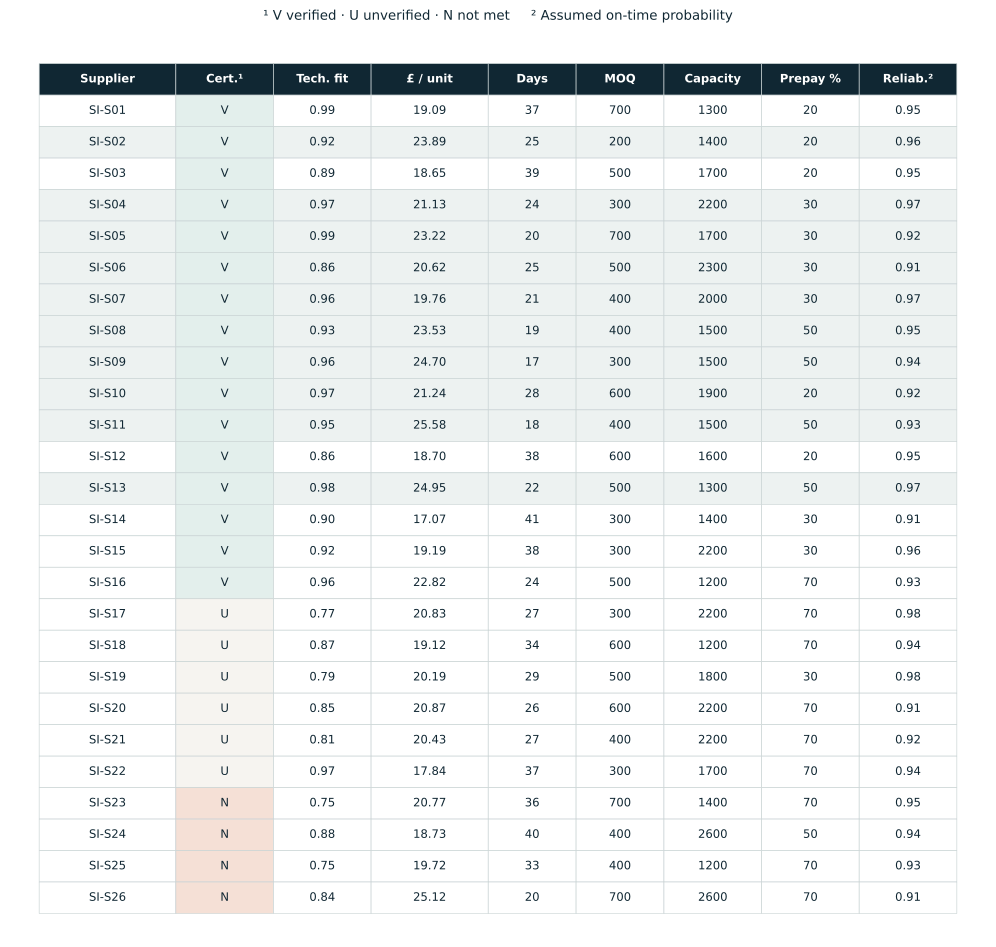
- 26 synthetic supplier records. Procurement quantities are integers; demand, qualification, MOQ, capacity, prepayment, deadline and budget are hard constraints. Reliability is an explicit uncalibrated assumption, not a score or measured performance.
SI-01
Supplier Qualification Funnel
Scroll horizontally to inspect the complete figure.
SI-02
Multidimensional Supplier Matrix
Scroll horizontally to inspect the complete figure.
SI-03
Cost–Lead Time Pareto Frontier
Scroll horizontally to inspect the complete figure.
SI-04
Procurement Optimization Results
Scroll horizontally to inspect the complete figure.
Principal Findings
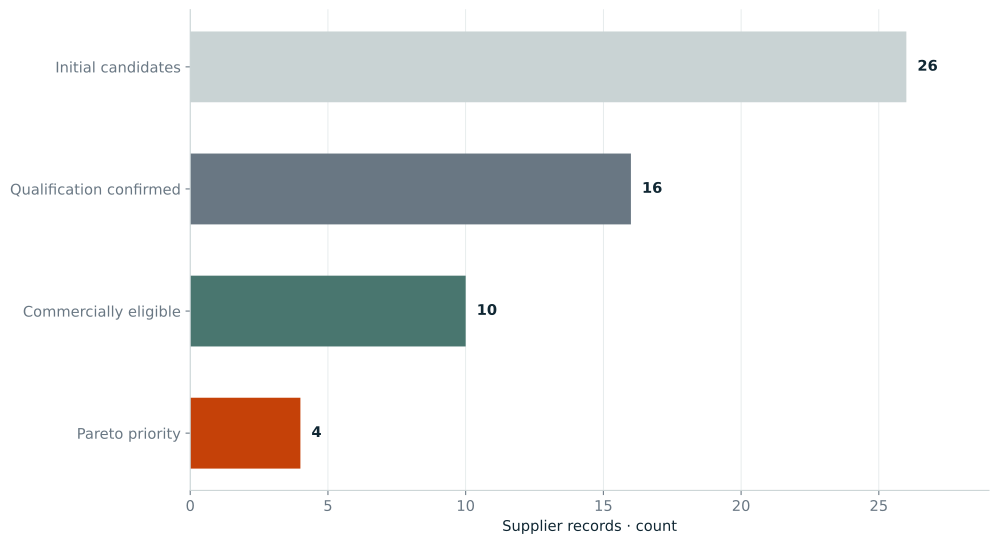
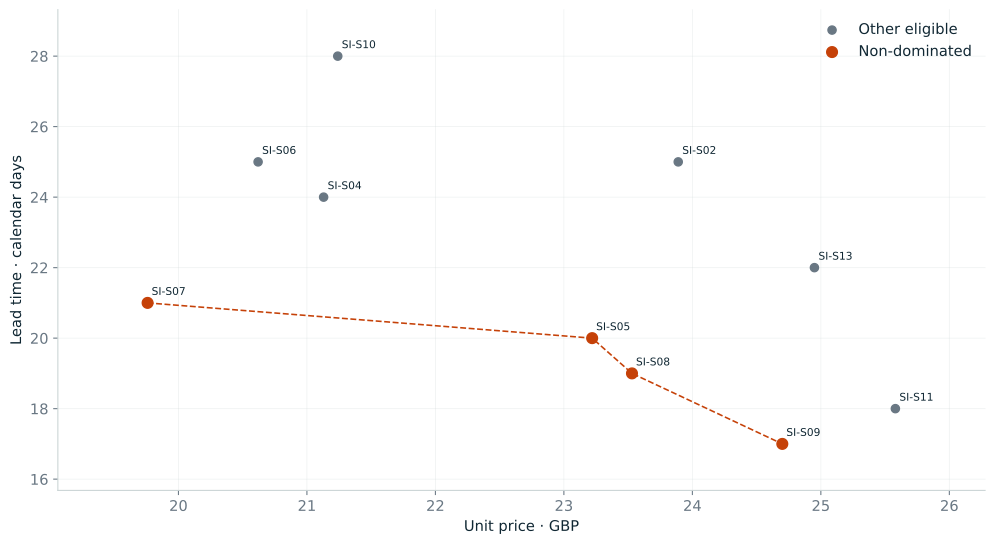
- The computed funnel retains 16 qualification-confirmed records, 10 commercially eligible records and 4 price–lead-time Pareto candidates. Six certification records remain pending and are not treated as failed.
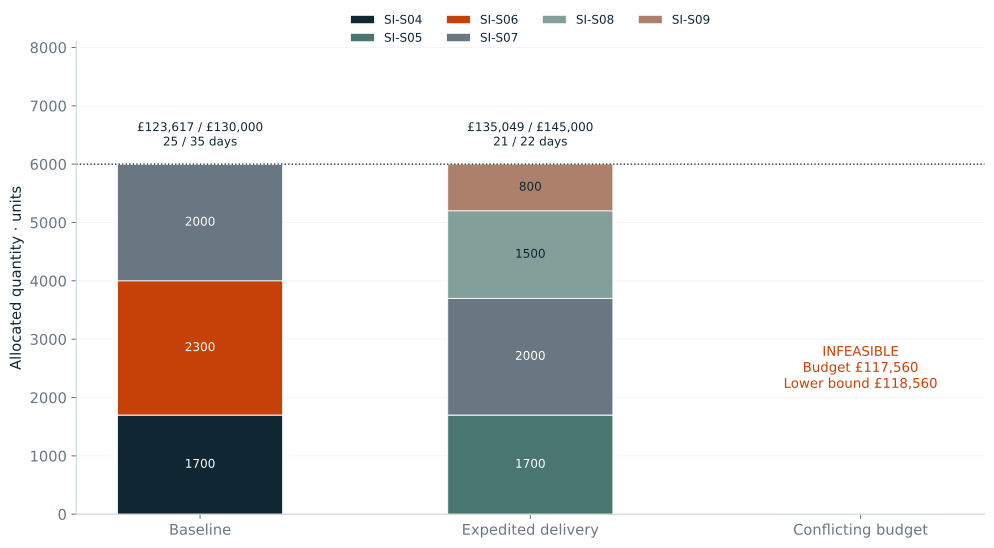
- CBC proves optimality for the baseline (£123,617) and expedited (£135,049) allocations. Their supplier combinations are SI-S04, SI-S06, SI-S07 and SI-S05, SI-S07, SI-S08, SI-S09, respectively.
- The conflict-case budget (£117,560) is below the relaxed cost lower bound (£118,560); the model correctly returns no feasible order.
Executive Interpretation
10 suppliers satisfy baseline qualification and commercial conditions. The least-cost feasible order totals £123,617; shortening the deadline to 22 days adds £11,432. Price-only ranking cannot determine the allocation because capacity and MOQ constrain the solution. Procurement approval remains conditional on qualification verification and confirmation of available capacity, terms and lead times.
Decision Conditions
- Before placing orders, confirm certification, specification compliance, order-specific capacity and the quoted payment/delivery terms. Pending certification requires evidence, not an adverse classification.
- Retain all commercially eligible suppliers in allocation analysis: a Pareto-dominated offer can still contribute useful capacity. Budget or delivery changes require the constrained model to be rerun.
Evidence Limitations
- Records are synthetic; assumed reliability is not a calibrated probability. No audit, certification validation, sample approval or real supplier recommendation is represented.
- Taxes, freight, currency changes, volume price tiers, quality losses and capacity correlated across suppliers are not modelled. Supplier lead times are assumed deterministic and orders are placed in parallel.